Artificial Intelligence is no longer a distant vision of the future. It is already part of our daily routines, often operating quietly in the background. When your phone suggests the fastest route home, when a streaming platform recommends a movie, or when a chatbot answers your questions online, AI is at work. What once seemed like advanced science fiction has become a practical tool that companies, governments, and individuals rely on every day.
But what we see today is only the beginning. The next decade will likely bring even deeper transformations. Artificial Intelligence is expected to reshape how we work, how businesses operate, how doctors treat patients, and how society functions as a whole. Understanding these changes is essential for anyone who wants to stay relevant, prepared, and competitive in a world increasingly powered by intelligent systems.
(You will be redirected to another page)
In this article, you will explore how AI will influence the future of work, business strategies, healthcare innovation, education, and everyday life. More importantly, you will understand how to adapt and benefit from these changes rather than fear them.
Understanding the Rapid Growth of AI
Before looking at the future, it helps to understand why AI is advancing so quickly. Three main factors are driving this growth: more data, more computing power, and better algorithms.
Today, billions of devices generate enormous amounts of data every second. Smartphones, sensors, cameras, and online platforms continuously produce information that AI systems can learn from. At the same time, cloud computing allows companies to process this data faster and cheaper than ever before. Finally, improvements in machine learning and deep learning techniques make AI models smarter and more accurate.
Together, these factors create an environment where AI evolves rapidly. What was impossible five years ago is now common. This pace of change will likely continue, leading to even more powerful and accessible technologies.
How AI Will Transform Work and Careers
One of the most significant impacts of AI will be on the job market. Automation is already replacing many repetitive and routine tasks. In factories, robots assemble products faster than humans. In offices, software handles data entry, scheduling, and basic customer service. In retail, self-checkout systems reduce the need for cashiers.
At first glance, this may seem threatening. Many people worry that machines will take all jobs. However, the reality is more complex. While some roles disappear, new ones are constantly created.
As AI handles repetitive tasks, humans can focus on higher-value activities that require creativity, empathy, and strategic thinking. Jobs in AI development, data analysis, cybersecurity, digital marketing, and automation management are growing rapidly. Even traditional professions are changing rather than disappearing.
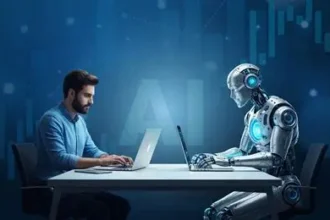
For example, teachers use AI tools to personalize lessons. Lawyers use AI to review documents faster. Designers use AI to generate ideas. Instead of replacing professionals, AI often becomes an assistant that increases productivity.
The future workforce will need different skills. Critical thinking, problem-solving, communication, and digital literacy will become more important than memorizing information. Continuous learning will be essential. People who adapt and learn how to work alongside AI will have more opportunities than ever before.
(You will be redirected to another page)
AI in Business: Smarter Decisions and Greater Efficiency
Businesses are already using AI to become faster, smarter, and more competitive. In the future, this trend will only intensify.
AI helps companies analyze large amounts of customer data to understand preferences and behaviors. This allows businesses to offer personalized experiences, targeted advertisements, and better products. Instead of guessing what customers want, companies can rely on real insights.
Automation also reduces costs. AI-powered systems can manage inventory, forecast demand, detect fraud, and optimize supply chains with minimal human intervention. This improves efficiency and reduces errors.
Customer service is another area being transformed. Chatbots and virtual assistants provide instant responses 24 hours a day. While complex issues still require humans, many simple questions can be solved automatically.
Small businesses benefit as well. Tools that once required large teams and expensive software are now accessible through affordable AI platforms. Entrepreneurs can use AI for marketing, content creation, financial planning, and customer support.
In the future, companies that ignore AI may struggle to compete. Those that embrace it strategically will likely grow faster and serve customers better.
The Revolution of AI in Healthcare
Healthcare is one of the fields where AI can have the most positive impact on society. Intelligent systems are already helping doctors diagnose diseases, analyze medical images, and predict health risks.
AI can process thousands of medical records in seconds and identify patterns that humans might miss. For example, algorithms can detect early signs of cancer in X-rays or predict heart problems using patient data. Early diagnosis often means better treatment and higher survival rates.
Hospitals also use AI to manage resources more efficiently. Scheduling systems reduce waiting times, while predictive tools help plan staff and equipment needs. This improves patient care and lowers costs.
Wearable devices and health apps powered by AI allow individuals to monitor their health in real time. Smartwatches track heart rate, sleep quality, and physical activity. These tools encourage preventive care rather than only treating illnesses after they appear.
In the future, AI may support personalized medicine, where treatments are tailored specifically to each patient’s genetic profile and lifestyle. This could make healthcare more accurate, affordable, and accessible worldwide.
Education and Learning in an AI-Powered World
Education is also changing because of Artificial Intelligence. Traditional classrooms often follow a one-size-fits-all approach, but students learn at different speeds and in different ways. AI helps personalize learning experiences.
Educational platforms can analyze student performance and adapt lessons automatically. If a student struggles with a topic, the system provides extra practice. If they progress quickly, it offers more advanced material. This makes learning more efficient and engaging.
Teachers benefit too. AI tools can automate grading, track progress, and identify students who need extra help. This allows educators to focus more on teaching and mentoring rather than administrative tasks.
Online learning powered by AI will likely expand access to education worldwide. People can learn new skills from anywhere, which is especially important in a rapidly changing job market.
(You will be redirected to another page)
AI’s Impact on Society and Daily Life
Beyond work and business, AI will influence everyday life in many subtle ways. Smart homes will become more common, with devices that automatically adjust lighting, temperature, and security. Transportation may rely more on autonomous vehicles, reducing accidents and traffic congestion.
Cities will use AI-powered sensors to improve energy use, waste management, and public safety. This concept of “smart cities” can make urban life cleaner, safer, and more efficient.
Entertainment will also evolve. AI-generated content, personalized recommendations, and immersive experiences will change how people watch movies, play games, and interact online.
However, these benefits come with responsibilities. Issues like privacy, security, and ethical use of AI must be addressed carefully to ensure technology serves society positively.
Challenges and Ethical Considerations
While the future of AI is promising, it is not without risks. Data privacy, algorithmic bias, and job displacement remain important concerns. Governments and organizations must create regulations that protect people while encouraging innovation.
Transparency and accountability are essential. Users should understand how their data is used and how AI systems make decisions. Ethical guidelines will help prevent misuse and ensure fairness.
Technology should always prioritize human well-being.
Final Thoughts
Artificial Intelligence is not just another technological trend. It is a powerful force that will reshape work, business, healthcare, and society in profound ways. From smarter companies and better medical care to personalized education and more efficient cities, AI has the potential to improve life for millions of people.
At the same time, adapting to this new reality is crucial. Learning new skills, staying informed, and embracing technology rather than resisting it will make all the difference.
The future of AI is not something that simply happens to us. It is something we help create. By using Artificial Intelligence responsibly and intelligently, we can build a future that is more productive, innovative, and inclusive for everyone.
 Keep an eye on this