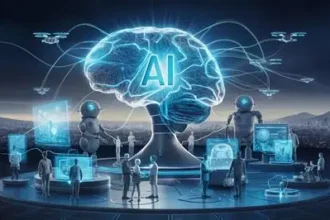
Artificial Intelligence has entered a new phase in 2026. What began as a tool for automation is rapidly evolving into systems capable of autonomous decision-making, complex reasoning, and real-time adaptation.
No longer confined to research labs or large tech corporations, AI is now embedded in everyday tools, enterprise systems, and global infrastructure. Its influence extends far beyond efficiency gains — it is fundamentally reshaping how economies function, how businesses compete, and how individuals work.
(You will be redirected to another page)
As AI continues to mature, understanding its broader impact is no longer optional. It is essential.
🌐 The shift from automation to intelligent systems
In its early stages, AI was primarily used to automate repetitive and rule-based tasks. Today, the technology has evolved into something far more sophisticated.
Modern AI systems are capable of:
- Understanding natural language with high accuracy
- Generating human-like text, images, and code
- Making predictive decisions based on large datasets
- Learning and improving without explicit reprogramming
This shift marks the transition from simple automation to intelligent systems that can operate with a degree of independence.
📊 AI as a driving force in the global economy
Artificial Intelligence is now one of the most powerful drivers of economic transformation. Companies that adopt AI effectively are gaining significant competitive advantages in speed, scalability, and innovation.
AI is reshaping industries such as:
- Finance, through algorithmic trading and fraud detection
- Healthcare, with diagnostic tools and predictive analytics
- Retail, via personalization and demand forecasting
- Manufacturing, through smart automation and robotics
- Marketing, with data-driven targeting and content generation
As a result, AI is not just improving existing processes — it is redefining entire business models.
(You will be redirected to another page)
Autonomous systems and the future of operations
One of the most significant developments in AI is the rise of autonomous operations. Businesses are increasingly deploying systems that can manage entire workflows without constant human oversight.
Examples include:
- Self-optimizing supply chains
- Autonomous customer service platforms
- AI-driven financial management systems
- Smart infrastructure and energy management
These systems reduce operational costs while increasing speed and precision, allowing organizations to operate at scales previously unimaginable.
💼 The transformation of jobs and workforce dynamics
As AI becomes more autonomous, the nature of work is changing. Rather than simply replacing jobs, AI is redefining roles and creating new categories of employment.
Emerging dynamics include:
- Shift from manual execution to strategic oversight
- Increased demand for interdisciplinary skills
- Growth of roles focused on AI supervision and alignment
- Expansion of hybrid human-AI collaboration models
Workers are now expected to complement AI systems, focusing on areas where human judgment, creativity, and ethics are essential.
🌍 Global competition and the AI divide
AI is also reshaping global economic competition. Countries and organizations that lead in AI development are gaining significant strategic advantages.
This has created what many refer to as the “AI divide”:
- Nations with advanced AI infrastructure are accelerating growth
- Developing economies face challenges in adoption and integration
- Access to data and computing power is becoming a key resource
As a result, AI is not just a technological issue — it is a geopolitical and economic one.
(You will be redirected to another page)
Ethics, control, and the risks of autonomy
With increased autonomy comes increased responsibility. AI systems making independent decisions raise important ethical and regulatory questions.
Key concerns include:
- Accountability for AI-driven decisions
- Transparency in autonomous systems
- Bias and fairness in algorithmic outcomes
- Loss of human control in critical systems
Ensuring that AI operates within ethical boundaries is one of the biggest challenges facing governments and organizations today.
🚀 The next phase: toward fully autonomous ecosystems
Looking ahead, AI is expected to evolve into fully autonomous ecosystems where interconnected systems operate seamlessly across industries.
Future developments may include:
- Entirely autonomous business operations
- Smart cities powered by AI-driven infrastructure
- Real-time global supply chain optimization
- Self-regulating financial and economic systems
These advancements will further blur the line between human-led and machine-driven environments.
✅ Conclusion
Artificial Intelligence in 2026 marks a turning point in the evolution of technology. The shift from automation to autonomy is not just enhancing efficiency — it is redefining the structure of the global economy.
As AI continues to evolve, the ability to understand, adapt, and strategically leverage these systems will determine success for individuals, businesses, and nations alike.
In this new era, AI is no longer just a tool — it is a foundational force shaping the future.
 Keep an eye on this